
My childhood was written before I even had the chance to live it.
During my youth in Yugoslavia, life followed a predictable pattern. My parents worked in the factory. We lived in a concrete apartment building. The script was simple: go to school, get a job, get married, start a family.
It was a system—reliable, grey, and structured.
But I was a lively boy, perhaps too curious for the rigid lines of communism. I wanted “more,” even though I didn’t yet know what “more” looked like.
That curiosity often led me into trouble.
One day, after a foolish childhood mistake involving a petty theft, I found myself running—not toward a dream, but away from consequences.
I ducked into a church on the town square looking for somewhere to hide.
What I expected was judgment.
What I found instead was silence.
Not empty silence, but the kind that wraps around you like a blanket.
I found a priest whose kindness was not tied to my behaviour. He did not see a “problematic” boy. He saw a child searching for shelter.
I became an altar boy during a time when faith was often practiced quietly, almost secretly. In many ways, that church became my first sanctuary.
It was also my first encounter with a peace that did not come from a political system, authority, or control.
Faith and I have had a long and complicated relationship.
We were like old friends who repeatedly stopped speaking to one another.
During the Homeland War, the silence of God became deafening.
I looked at destruction, suffering, death, and broken families, and I could not make the mathematics of faith work anymore.
How could a loving God allow such horror? I saw people on the “other side” praying to the same God, using the same prayers for a different victory.
At times, it felt as though God had simply switched off His hearing aid.
So, I walked away.
Years later, the silence returned—but this time it was deeply personal.
My world collapsed in a completely different way when my son Matteo received an epilepsy diagnosis. Suddenly, I was facing something I could not fight, negotiate, investigate, or control.
I looked at my boy, then looked toward the sky, and asked the oldest question in human history:
“Why me?”
I did not want philosophy.
I did not want a system.
I wanted a miracle.
And when that miracle did not arrive on my timeline, I walked away from God once again.
I did not begin the Camino de Santiago for religious reasons.
If somebody had asked me at the airport why I was going, I probably would have said I needed a break, a challenge, or simply space to clear my mind after years of business pressure and responsibility.
But looking back now, I think my soul was simply tired of being frustrated.
I chose the Camino Primitivo—the “Original Way.”
The pilgrimage begins in Oviedo at the Cathedral of San Salvador, a magnificent Gothic structure standing proudly since the 9th century. It sits in the heart of Asturias—a place of stone, rain, shadows, and centuries of whispered prayers.
When I first stepped inside, the professional in me admired the architecture.
But the person in me completely fell apart.
I touched the cold stone walls, and suddenly the tears I had been holding back for years—since the war, since Mateo’s diagnosis, since years of trying to remain “strong”—finally arrived.
I was not asking God for something new.
For the first time in many years, I was simply grateful.
Matteo was healthy.
I was independent.
I was alive.
And in that moment, I realized something that changed everything:
I had not come to Spain to find God.
I had come to stop running from Him.
The Camino Primitivo is not a gentle pilgrimage.
It is rugged, isolated, mountainous, and physically demanding. It asks questions of your body that modern life rarely asks anymore.
During those fifteen days, my faith was tested—not only faith in God, but faith in myself.
There were mornings when my legs felt like concrete and the fog was so thick I could barely see ten feet ahead.
In business, when things become difficult, you organize meetings, adjust strategy, and pivot direction.
On the Camino, there is only one strategy:
Keep walking.
Slowly, I began seeing parallels between the trail and my life.
The steep climbs became every crisis I had survived.
The isolated stretches became the moments I felt abandoned.
And yet, every time I believed I could not continue, another yellow arrow appeared.
Every time loneliness crept in, another pilgrim would smile and quietly say the following:
“Buen Camino.”
Somewhere along the trail, I realized that the “problematic” curiosity I carried as a child was never really rebellion.
It was an exploration.
I had a need to understand what existed beyond the next hill.
And for the first time in my life, I was not punished for it.
I was exactly where I was meant to be.
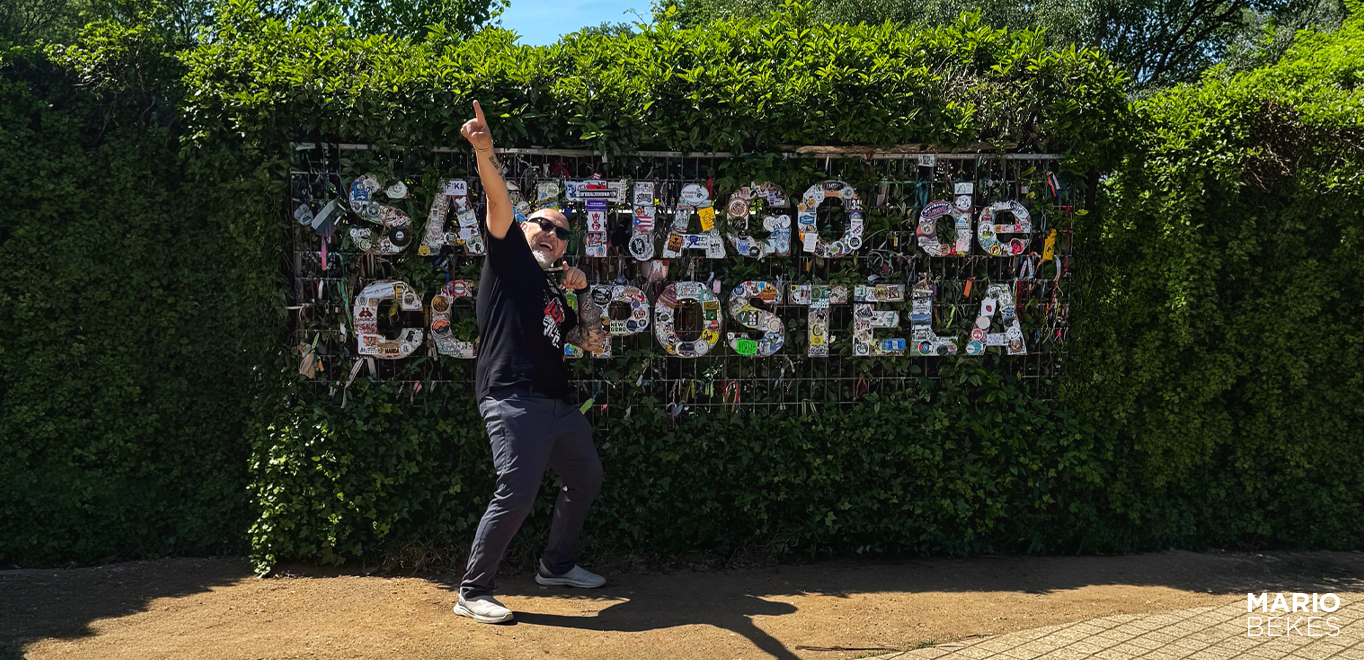
When I finally saw the spires of the Cathedral of Saint James in Santiago de Compostela, I did not feel like a conqueror.
I felt like that frightened little boy again—the one hiding inside a church searching for safety.
Standing before the remains of St. James the Elder, an apostle who travelled across continents carrying hope, I felt a profound sense of closure within me.
The Middle Ages met the modern world in that plaza.
I watched people aged eighteen to eighty crying, hugging, laughing, and standing silently together in exhaustion and peace.
We all arrived carrying different stories.
But we all shared the same look in our eyes.
Relief.
I realized then that I had succeeded—not because I completed the kilometers, but because I finally ended the argument I had been having with life itself.
Throughout the entire journey, the rhythm beneath my thoughts had slowly changed.
No longer:
“Why me?”
But instead:
“Thank you.”
I was grateful for success but also for failure.
Grateful for achievement, but also for suffering.
Grateful for the friends who walked beside me and the strangers who shared bread, shelter, silence, and kindness.
Before I left, a friend told me the Camino might reconcile me with both God and myself.
She was right.
But reconciliation did not arrive through sermons or theology.
It arrived through dirt, sweat, exhaustion, silence, and surrender.
The journey did not end in Spain.
Something inside me felt pulled toward Rome, as though the thread of the pilgrimage needed one final chapter.
Walking through the Vatican Museums surrounded by centuries of history, art, and human ambition, I felt the scale of civilization itself.
But it was entering St. Peter’s Basilica that truly completed the pilgrimage for me.
From a small village church in Yugoslavia to the grandest basilica in the world, the feeling was exactly the same.
Peace.
The peace I felt standing beneath Michelangelo’s dome was the same peace I experienced as a frightened boy hiding from police consequences inside a church.
And perhaps that became the greatest lesson of all:
God is not found in the size of the building.
God is found in the magnitude of one’s surrender.
I am writing the letter now from a seat on a plane.
Below me, the clouds resemble the mountains I climbed in Asturias.
I am traveling home, but I am not returning to the “system.”
I am returning to life through the lens of gratefulness.
I cannot wait to embrace Matteo.
I cannot wait to tell the people I love that, after all these years, I finally feel at peace.
I started this journey as a man carrying maps and a thousand questions.
I am finishing it as a man carrying no map at all— only a single word:
Grateful.
Life is not a checklist of achievements and responsibilities.
It is a pilgrimage meant to be walked.
And sometimes, you must travel all the way to Spain and Rome just to realize that the shelter you were searching for was inside you the entire time.