
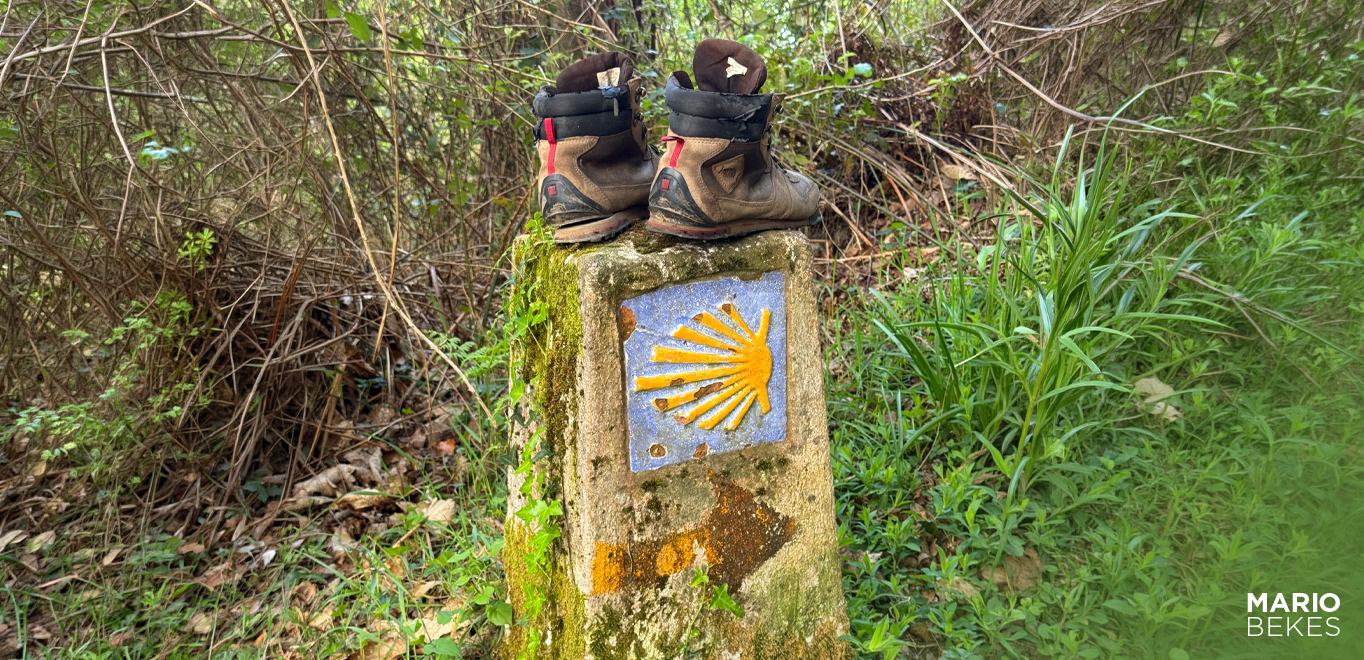
The soles of my boots were still caked with the red earth of Asturias.
Only days earlier, I had been a pilgrim on the Camino Primitivo, tracing the rugged, lung-burning path of King Alfonso II through the Cantabrian Mountains.
On the Camino, life is stripped back to its skeletal essentials:
a backpack, a yellow arrow, and the rhythmic percussion of a walking stick against stone.
But as I stood on Roman pavement clutching a suitcase instead of a pilgrim’s staff, I realized something important:
The pilgrimage had not ended.
It had simply changed its wardrobe.
I arrived in Rome not as a conquering general, but as a man vibrating with the strange cocktail of post-trek exhaustion and pre-adventure anxiety.
All roads, it is said, lead to Rome.
What they never mention is the emotional baggage you carry when you finally arrive.
Inside me lived two very different worlds: the frantic excitement of a traveller trying to navigate foreign ATMs, train stations, and unfamiliar streets, and the slower, quieter version of myself forged somewhere inside the Spanish mist.
My first lesson in Roman survival arrived in the form of coffee.
Forget everything you know about “coffee to go.”
In Italy, coffee is not simply a beverage.
It is a ritual.
Speed.
Chemistry.
Identity.
Conversation.
I found a tiny café near my hotel in the Centro Storico. The air smelled of burnt sugar, espresso, and old stone soaked in centuries of history.
Following the locals, I stood at the zinc bar—sitting down is apparently reserved for tourists and people with unlimited time— and ordered a ristretto.
For the uninitiated, a ristretto is espresso reduced to its most concentrated and dangerous form.
It is what happens when regular espresso is told a dark secret and becomes emotionally intense.
Smaller.
Darker.
More concentrated.
More unforgiving.
It arrived in a cup so tiny it looked like something stolen from a dollhouse.
One sip and I did not simply wake up.
I became aware of my own cellular structure.
The flavour was thick, syrupy, almost violent in its intensity, but balanced by a lingering sweetness that somehow cut through my lingering Camino fatigue.
I attempted conversation with the barista using my modest and somewhat clumsy Italian.
His face—previously carrying the classic Roman expression of theatrical indifference—softened immediately to a genuine smile.
“Bravo,” he nodded, sliding a small glass of sparkling water toward me.
Amidst that exchange, the “business executive” within me quieted down.
The pilgrim returned.
Because whether you are walking 300 kilometres across Spain or simply three blocks through Rome, the bridge between people remains the same: effort, curiosity,
and shared humanity.
Eventually, I wandered toward the Trevi Fountain—Rome’s roaring, theatrical heart.
I expected cynicism.
After all, it is perhaps the most famous tourist ritual on Earth.
But as I rounded the corner and heard the crashing water before fully seeing it, my breath caught unexpectedly.
The Trevi is not merely architecture.
It is a theatre carved into stone.
Commissioned by Pope Clement XII in the 1700s, the fountain stands at the endpoint of the ancient Aqua Virgo aqueduct — the “Virgin Water” that once supplied Rome itself. Legend says a young girl guided thirsty Roman soldiers toward the spring in 19 BC.
Standing there, staring at the relief carved into the stone, I felt an unexpected kinship with her.
Both of us, in our own strange ways, were simply trying to guide ourselves toward the source.
At the centre stands Neptune, balanced between calm and chaos atop a shell-shaped chariot pulled by two opposing seahorses: one wild, one is disciplined.
The symbolism felt strangely familiar.
Every life contains both.
I stood in the cool Roman mist, reached into my pocket, and held a coin in my hand.
The city now controls crowd access more carefully, but the ritual itself remains sacred.
right hand, left shoulder throw.
Clink.
Nearly 3,000 Euros are tossed into the Trevi every single day. The money now supports charitable programs across Rome through Caritas.
I loved the irony of that.
A fountain originally built to glorify papal power, and Roman grandeur had quietly evolved into a humanitarian river helping feed and shelter people in need.
My coin was no longer simply a wish.
It became participation.
From the Trevi, I slowly wandered toward Piazza di Spagna.
After the brutal vertical punishment of the Camino Primitivo, the Spanish Steps looked almost humorous by comparison.
“Is that all?” I quietly thought to myself.
Built in 1723 to connect the Bourbon Spanish Embassy with the church of Trinità dei Monti above, the staircase remains one of the most recognizable public spaces in the world. At its base rests the Fontana della Barcaccia—the “Ugly Boat.”
Legend says the Tiber River flooded in 1598, and when the waters finally receded, a broken boat remained stranded in the square.
Bernini transformed that struggle into sculpture.
Rome has always understood something modern society often forgets:
Beauty and suffering usually arrive together.
I climbed the steps slowly.
One step for fear.
One step for uncertainty.
One step for gratitude.
By the time I reached the top, Rome unfolded beneath me like a terracotta dream fading into golden afternoon light.
Unlike modern cities obsessed with pretending to be young, Rome wears its age openly.
Its ruins are not hidden.
They are displayed like jewellery.
As the day grew warmer, I suddenly felt the urge for a cappuccino.
But then I checked my watch.
10:45 a.m.
Dangerously close to the cultural cut-off point.
In Italy, ordering a cappuccino after 11:00 a.m. is treated somewhere between social confusion and low-level criminal behaviour.
The reasoning is simple: Italians believe milk disrupts digestion after meals.
And digestion here is treated with greater seriousness than most legal systems.
A proper cappuccino follows a sacred balance: one-third espresso, one-third steamed milk, one-third foam.
Soul.
Body.
Spirit.
This time, I chose to sit down, consciously disregarding my usual practice of standing at the bar like a local, and accompanied my decision with a warm cornetto.
And suddenly, breakfast stopped being breakfast.
It became meditation.
The foam was impossibly dense.
The espresso is sharp but balanced.
Around me, Romans spoke with dramatic hand gestures and full emotional commitment, somehow transforming ordinary conversation into live theatre.
And sitting there, somewhere between exhaustion and contentment, I realized something simple:
On the Camino, I learned how to be alone.
In Rome, I was learning how to be alive again.
Rome, much like the Camino, functions as a mirror.
If you arrive searching only for a vacation, you will encounter crowds, queues, noise, and overpriced gelato.
But if you arrive as a pilgrim—curious about the invisible threads connecting the ancient world to our modern anxieties— the city reveals something much deeper.
You begin noticing that Neptune is still trying to calm the sea.
That a young girl guiding soldiers toward water two thousand years ago still shapes the city today.
And sometimes a tiny, bitter cup of coffee is all that stands between exhaustion and spiritual clarity.
My Italian remains weak.
My legs remain worn.
But as shadows slowly stretched across the Spanish Steps that evening, I realized the coin I threw into the Trevi Fountain was never truly about returning to Rome.
It was a promise to me: to never stop searching for the eternal hidden inside ordinary life.
And so, the journey continues.
Not because I am lost.
But because there is still so much left to discover