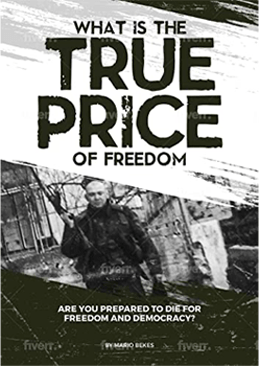
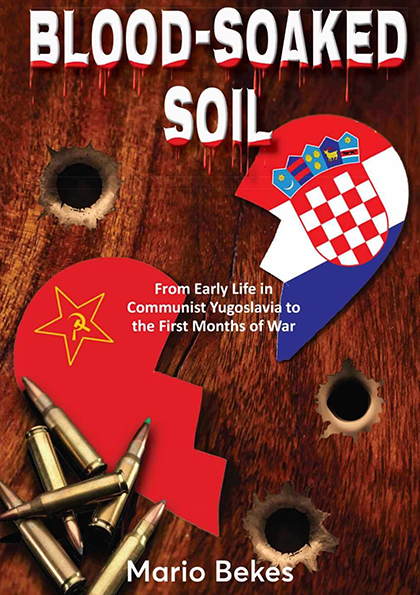
Blood Soaked Soil – part one

Imagine yourself in my shoes. Imagine being 18-years-old, and in just 24 hours the world you knew stopped existing. Imagine being a teenager and learning all these skills that were designed for one purpose – to kill others. Growing up in Communist Croatia (then part of Yugoslavia), Mario Bekes witnessed a lot of social unrest – before finding himself in the middle of the Croatian War of Independence. Mario’s world quickly turned upside down. One morning he woke to a knock at the door. His family and his girlfriend were gone. His neighbours were packing, fleeing the city. And the military were at his door, saying, “Report at the army barracks in one hour.”

Competitive Business Intelligence

In business world intelligence and counterintelligence become more and more important element in creating success and wealth on the market for small, medium and large organisation and companies as well in minimising risks from being take over, fraud, industrial espionage, theft of intellectual property, blue prints, and trade secrets and list goes on.

Regardless if you are just about to start your private business or you are in the sit as decision maker in large organisation you will heavily depend on gathered intelligence about your competitor or their product.

Most of the time organisation will use softwares to analyse collected data or they will use external company (contractor) to analyse their competitor or product.

Saying that, did you ask your self how some external company collecting data about your competitor, how this data is stored, who has access to this data and perhaps this data is collected on your behalf and in the end is presented to your client. Do you have control over information? How this data is validated?

Do you believe that giving to your employee or contractor Confidentiality Agreement solve all your problems in preventing industrial espionage or perhaps fraud or in the end theft of your intellectual property? No, it is your liability to protect information and trading secret and in case that intellectual property is stolen, it becomes hard to prove who and when take this information (intellectual property), at the end loss of intellectual property can cause downfall of company, shattered their reputation in the market, confidence in investors or stakeholders.

Perception is reality, and with accurate intelligence your perception will increase and give you benefits in performing better on market, in protecting intellectual property.

Corporate and Workplace Investigations

For as long as there have been people, there has been crime. Certainly, in early human history, much crime would have been violent, but some less so. The first laws aimed at kerbing human venality and rage date back to around 1754 BC, with the Code of Hammurabi noting various punishments for various acts. And where there is law, there must be investigation: to establish facts and provide evidence.

Of course, there are strong links in early history, as well as in some soci- eties in the present day, between religion and crime, with notorious reli- gious investigators such as the Spanish Inquisition. Much of our modern understanding of crime and punishment, and its investigation (through Socratic debate about evidence and its surety) is traced to the writing of the Greek philosophers Plato and Aristotle. The Roman Republic of course bequeathed an approach to law that remains influential to this day.

That said, it is unfortunate that the Middle Ages marked a remarkably backward step away from Roman secular law, to a rather more colourful interpretation, often based on what would now be termed religious ex- tremism. However, extremism fortunately gave way to forgiveness and compassion.

Importance of Establishing Identity in Factual Investigations

Investigations are part of daily routine, in every aspect of life and there is no certain moment in history which we can use as a starting point to define investigation, however investigations are improving, implementing and evolving since the dawn of humankind.

Our ancestors certainly used intuition and some type of skills to make conclusion about events, how to gain competitive edge or to win over their opponents. They also used some form of evidence or facts. Since then investigation methodology and tactics have evolved immensely, to a scale that ordinary people can only imagine.

Investigation doctrine is not the classic scene where a detective smashes a suspect on the head to get them to admit guilt. It has evolved with the legal and judiciary system by protecting the individual from an abuse of their legal rights.

Mic to Millions

How You Can Go from Unknown to Unstoppable with the Power of Podcasting.

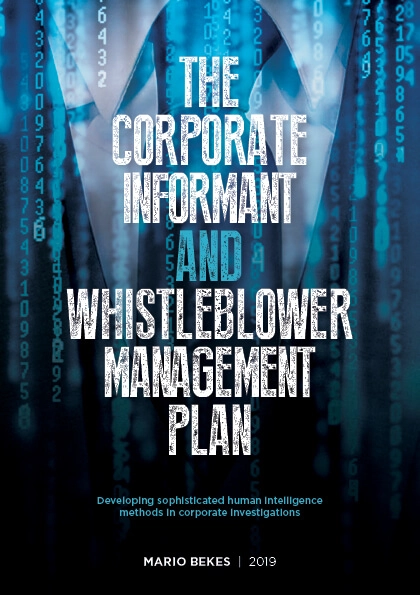
The Corporate Informant and Whistleblower Management Plan

“The word informant in society has negative connotations, and indeed most people in this position are isolated from society.” (Corporate and Workplace Investigations-Crime Investigative and Interviewing Techniques, 2018, Bekes/Smallman, PP 74).

Defining what or who an informant is, is more complex than previously thought. This is particularly relevant in today’s very turbulent world in which governments collapse overnight, civil wars escalate and markets are unpredictable. The informant can be anyone.

The official definition of informant: person who gives information (Collins English Dictionary & Thesaurus, 2011, pp 455) There are different types of informants based on motive and these form part of the intelligence management cycle, falling under the category of Clandestine Information Collection.

How often do we watch Hollywood blockbusters in which a cop flies out of the car and presses some snitch against a wall, demanding information about somebody or something? The reality is far more pervasive than the movies. The history of informants reached a pinnacle during the Cold War and without doubt, the Warsaw Pact (1955 -1991) countries assimilated their entire populations into the informant role.