
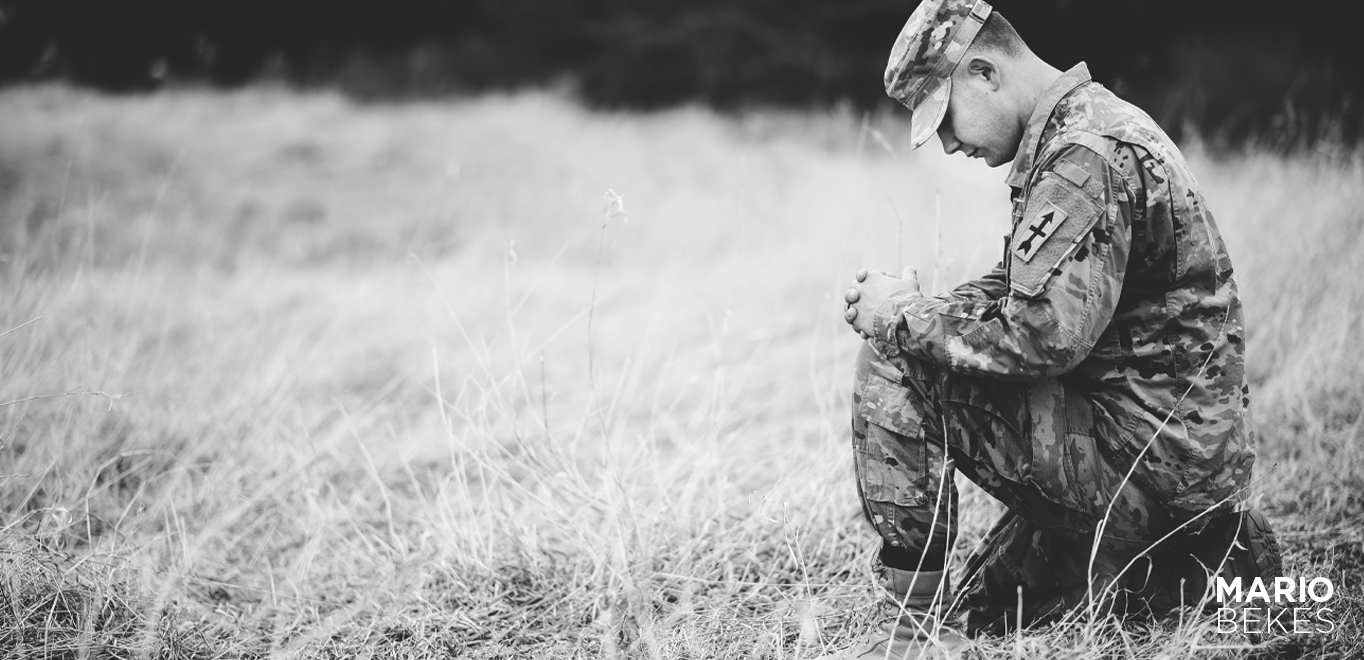
At 2am on a winter night, in temperatures below minus ten degrees, someone called out for “lunch.”
In military operations, conventional timekeeping is irrelevant. We were preparing to move toward enemy lines—a-controlled advance requiring silence, proximity, and calculated risk. Close enough that one could see breath crystallizing in the cold air.
Before each deployment, a ritual preceded us.
A priest would arrive. Holy water. Rosaries. A short prayer. The words were consistent: “God will protect you. God is with the righteous.”
Formally, the sermon resembled the Anointing of the Sick. Informally, soldiers understood its practical meaning: psychological reinforcement before exposure to mortal risk.
I grew up under communism and chose to serve as an altar boy. Churches were sparsely attended. Religion existed but was peripheral to state ideology. War changed that dynamic rapidly.
Religious institutions became central to national identity. Priests became influential voices in public morale. Questioning them was unwise.
I questioned anyway.
Twenty-four hours after receiving our blessing, we lay concealed near an opposing village. From that proximity, I could hear enemy soldiers conversing.
Then I witnessed something operationally revealing: a priest among them. The priest, with a long beard and a cigarette in his hand, was distributing holy water and rosaries to the soldiers. The same assurances. The same certainty that God stood with them.
The phenomenon was not a theological paradox; it was a strategic observation.
If both sides claimed divine endorsement, the operative question emerged: whose side was God on?
When I later posed this question hypothetically, I was reprimanded. The issue was not doctrinal accuracy; it was structural stability. Faith in wartime functions as cohesion. It frames sacrifice as righteous and suppresses destabilizing doubt.
That experience shaped my understanding: the word “God” can operate as currency—capable of mobilizing courage, simplifying moral complexity, and reinforcing collective narrative.
Years later, Nietzsche’s assertion—”God is dead… and we have killed him”—read less as philosophical provocation and more as commentary on human appropriation of the divine for temporal purposes.
And yet, war did not eliminate my belief in transcendence.
It refined it.
In contemporary society, faith competes with spectacle. Social media, commercialized spirituality, and algorithm-driven validation create noise that dilutes introspection. In this environment, meaning becomes fragmented.
It is within this context that I have chosen to undertake the Camino.
Not as an act of religious revival, nor as symbolic theatre. Rather, as a structured withdrawal.
Senior professionals understand the value of recalibration. Strategy requires pause. Leadership requires reflection beyond operational immediacy.
The Camino represents disciplined solitude—distance from noise to interrogate first principles.
I no longer ask which side God supports.
The more relevant inquiry is internal:
Am I aligned with integrity?
Am I aligned with responsibility?
Am I aligned with truth?
If divinity exists, it is unlikely to resemble tribal endorsement. It may instead resemble conscience.
The battlefield taught me the limits of certainty. The pilgrimage may teach me the discipline of listening.
Finding God, in this sense, is not a theological conquest.
It is the removal of interference.