
The clock on the studio wall was no longer a tool for measuring time; it had become a taunting predator.
44 hours.
The air in the room was thick, smelling of stale espresso and the sharp, metallic tang of adrenaline that flooded my system every time my eyelids grew heavy.
My voice, once resonant and steady, was now a ragged shadow of itself, scraping against the back of my throat.
I was speaking into the digital ether, tethered to the world only by a microphone and a glowing screen.
Then, the void opened.
I opened my mouth to continue a thought, but nothing came out. I could feel the muscles moving, the frantic command from my brain to my vocal cords, but the silence was absolute. I couldn’t hear myself. In that moment, the walls of the studio seemed to contract.
Panicked, I lunged out of the chair, my heart hammering against my ribs—
Only to realize I was in my bedroom.
I was awake. I was sweating. And I was three years removed from the most grueling physical and mental challenge of my life.
Even now, the echoes of those 55 hours and 26 minutes remain.
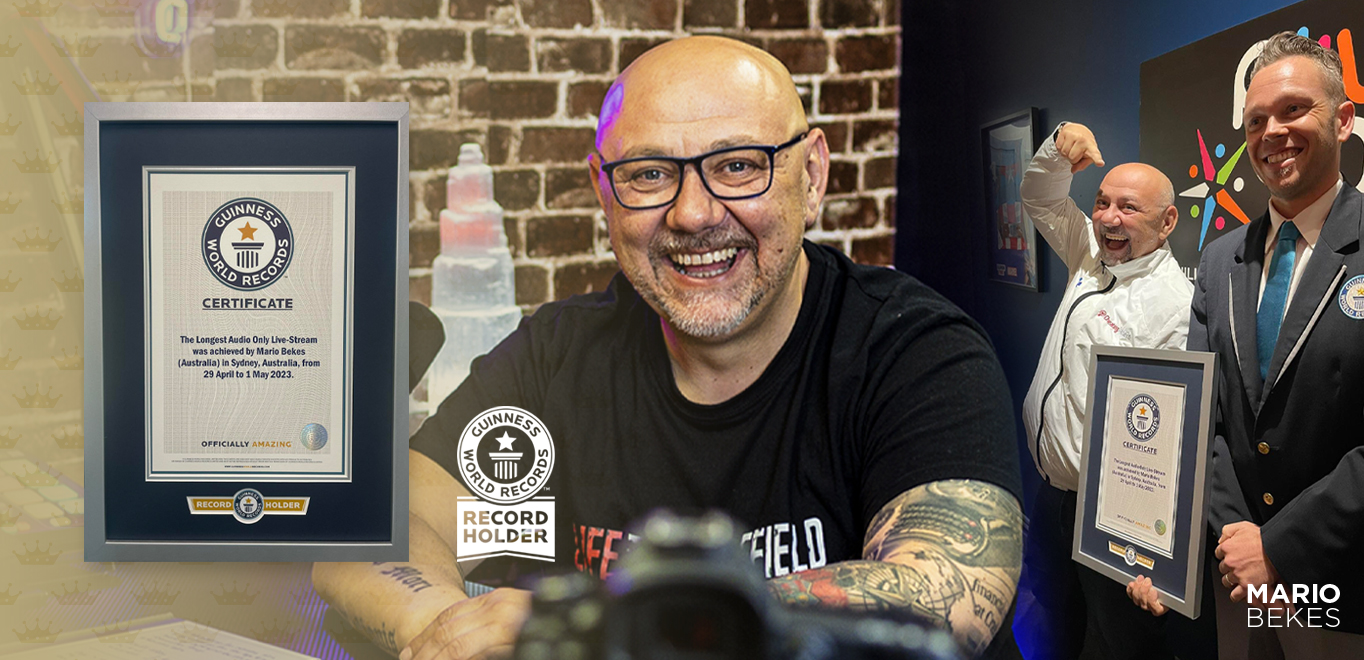
They call it a Guinness World Record for the “Longest Audio-Only Live Stream.” To the world, it’s a line in a book.
To me, it was the culmination of a journey that began on a dusty beach in 1980 and passed through the darkest trenches of war.
In the summer of 1980, the sun over our local beach felt like it would never set.
We were just a pack of boys with sun-bleached hair and scabby knees, obsessed with the Guinness Book of Records.
We didn’t just play. We competed.
We held our breath until our faces turned purple, trying to steal a second of immortality from the water. We counted push-ups until our arms collapsed. We laughed at records for the most sausages eaten.
Most of those boys grew up and left those dreams in the sand.
But something about that desire to reach the “impossible” stayed with me.
What I did not understand then—but learned later in war, in diplomacy, and in rebuilding my life in Australia—is this:
The impossible is rarely physical. It is psychological.
People see the record holder today, but they don’t see the man from Osijek who had to rebuild his identity from scratch in a foreign language, with limited words and unlimited pressure.
As I sat in that chair, I was never alone.
There is a toxic myth about the “self-made” man. It sounds powerful, but it is rarely true.
No dream survives the winter without a tribe.
As the hours stretched into days, my confidence wasn’t a static resource. It fluctuated. It dropped. It needed reinforcement.
I looked at the faces of my team—friends who sat in the digital waiting room just to make sure I knew someone was there.
Their belief became structure.
Their presence became stability.
Seeing people cheering for a 50-year-old veteran to finish a marathon of words… that does something to a man.
Some people I expected weren’t there. I don’t blame them. People have their reasons.
But those who showed up—my son, my friends, my peers, even strangers—became part of the outcome.
This is something I learned long before the studio:
Endurance is rarely an individual act. It is a collective force.
My journey to that record did not start on April 29th, 2023.
It started decades earlier.
Cold nights. Rain. Silence. Following foreign intelligence targets during war. Moments where stillness meant survival.
In those conditions, dreaming is not a luxury. It is a mechanism.
It gives the mind something to hold when everything else is uncertain.
I learned that leadership is not position—it is responsibility.
I watched commanders lead from the front. They showed us the “why” before demanding the “what.”
That stayed with me.
When I decided to attempt the record, I approached it the same way I approached operations:
Preparation before execution
Structure under pressure
Clarity when the body wants to shut down
At hour 12, motivation disappears.
At hour 24, the body negotiates.
At hour 40, the mind fractures.
What remains is not motivation.
What remains is training, discipline, and identity.
Audrey Hepburn once said, “Nothing is impossible; the word itself says ‘I’m possible.’”
At hour 50, that is no longer a quote.
It becomes a decision.
I often think of Dwight D. Eisenhower and the two letters he wrote before D-Day.
One was for victory.
The other was never meant to be seen. A letter taking full responsibility if the invasion failed.
As I sat in that studio, I carried my own version of that letter.
If I failed, it was mine alone.
If I succeeded, it belonged to everyone who believed.
This is where many people misunderstand ambition.
We are told dreaming is for children.
That after a certain age, ambition becomes unrealistic. Even embarrassing.
I reject that completely.
Dreaming is not age dependent. It is survival dependent.
Without it, discipline has no direction.
Without it, endurance has no meaning.
Three years have passed.
The record still stands.
But the record is not the achievement.
The achievement is this:
The boy from that beach in 1980 was not naïve.
He was correct.
We often wait for the “right time.”
More money.
More knowledge.
Better conditions.
Less risk.
But in my experience—from war zones to boardrooms—there is no perfect moment.
There is only preparation… and decision.
The impossible is not a barrier.
It is a label used by those who have not yet built a plan to confront it.
Whether you are in a boardroom, on a battlefield, or behind a microphone—
The principle does not change.
The dream is the engine.
But here is what experience teaches you:
An engine without discipline does not move.
An engine without structure breaks.
An engine without courage never starts.
You don’t need a perfect moment.
You need to turn the key.